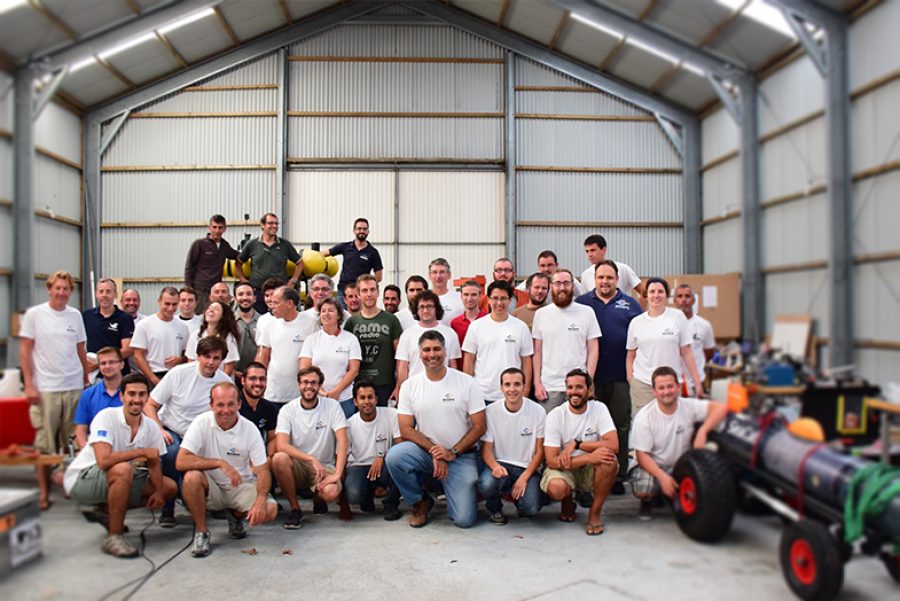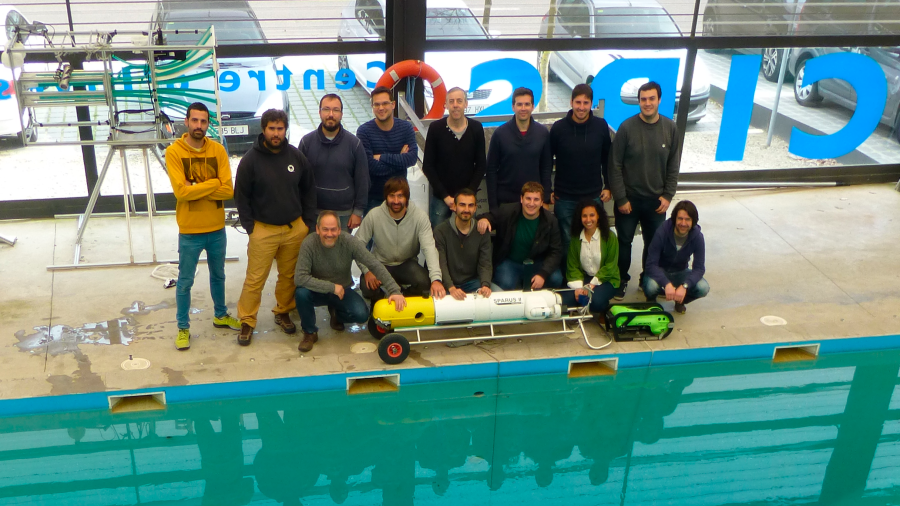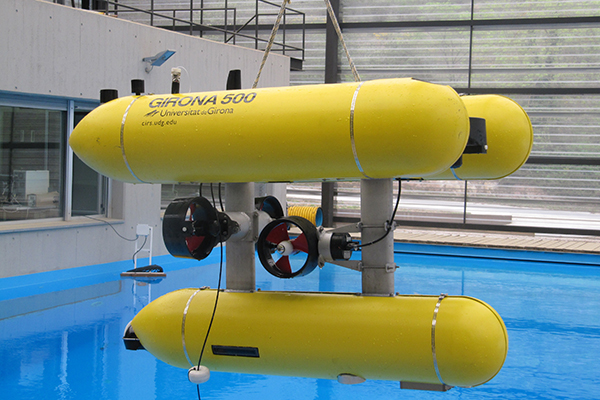
From 7-11th April 2014, a number of autonomous underwater and surface vehicles (robots) from several European institutions will be tested in the Costa Brava area, Spain. The tests will be carried out by 26 scientists from Germany, Portugal, Italy, France, and Spain. The major goal of these field trials is to demonstrate that the MORPH ensemble of vehicles can acquire data to map the sea bottom while operating in a cooperative manner and reacting to environmental conditions. The trials will focus on the execution of an optical and acoustic surveying mission with two surface and two underwater vehicles moving in formation and avoiding on-line detected obstacles. This is a preliminary step towards increasingly more complex cooperative missions over natural rugged terrain.
MORPH (Marine Robotic System of Self-Organising, Logically Linked Physical Nodes) is a four-year project funded by the European Commission that started in 2012, with an overall budget of approximately 8.4 millions of euros.
The institutions participating in the trails are: Atlas Elektronik (Germany), Ifremer (France), Jacobs University Bremen (Germany), IUT – Ilmenau University of Technology (Germany), Computer Vision and Robotics research Institute at the University of Girona (Spain), IMAR – Institute of Marine Research (Portugal), CMRE – NATO STO Centre for Maritime Research and Experimentation (Italy), IST – Instituto Superior Tecnico (Portugal), and CNR – Istituto di Studio Sui Sistemi Intelligenti per l’Automazione (Italy).
Groups of autonomous underwater vehicles are required to operate in areas where the visibility is low, obstacles are not known in advance, and a single vehicle would have very limited capabilities. The techniques enabling cooperative behaviour of the MORPH ensemble will pave the way for the development of advanced multi-vehicle systems capable of executing data acquisition and habitat mapping tasks in complex 3D environments (such as canyons and rugged cliff areas) in the presence of reduced visibility and natural unforeseen obstacles.
The hallmark of the MORPH project will be the demonstration, in 2015, of a system of multiple vehicles with complementary capabilities that will be able to perform complex missions underwater, under stringent operational conditions. This will be done by bringing together a number of simple and relatively cheap vehicles to seamlessly cooperate and behave as an ensemble: the “MORPH Supra Vehicle”. Such a system is expected to be launched in the market in 10-years time, offering an innovative solution to a large number of problems in a vast number of field applications: harbour protection, monitoring of industrial infrastructures (offshore wind power installations, pipelines…), sea mine detection, environmental monitoring, exploration of marine resources, archaeological surveys, to name a few.
We want to give special thanks to Ports de la Generalitat de Catalunya and Club Nàutic de Sant Feliu de Guíxols to let us use their facilities for the trials.
El projecte europeu del 7è Programa Marc MORPH: el proper pas cap al futur de la robòtica subaquàtica
Del 7 a l’11 d’Abril de 2014 vehicles submarins autònoms de superfície i submarins de diferents institucions europees es provaran conjuntament a la Costa Brava. Els experiments els duran a terme un total de 26 científics d’Alemanya, Portugal, Itàlia, França i Espanya. L’objectiu d’aquest treball de camp és demostrar que aquests vehicles poden operar coordinadament com a un tot. En concret, la missió que han de fer al mar és comunicar-se de manera autònoma mentre fan una trajectòria i aconseguir esquivar els obstacles que trobin sota l’aigua. Aquest és el primer pas per avançar cap a missions més complexes.
MORPH respon al títol en anglès Marine Robotic System of Self-Organising, Logically Linked Physical Nodes i és un projecte a 4 anys finançat per la Comissió Europea. Va començar l’any 2012 I té un pressupost total de 8,4 Milions d’Euros.
Les institucions que participen al projecte són: Atlas Elektronik (Alemanya) Ifremer (França), Jacobs University Bremen (Alemanya), Ilmenau University of Technology (Alemanya), Computer Vision and Robotics research Institute at University of Girona (Espanya), IMAR – Institute of Marine Research (Portugal), CMRE – NATO STO Centre for Maritime Research and Experimentation (Itàlia), Instituto Superior Tecnico (IST Portugal), CNR – Istituto di Studio Sui Sistemi Intelligenti per l’Automazione (Itàlia).
L’objectiu dels experiments que es faran a la Costa Brava és comprovar que els diferents vehicles són capaços de navegar conjuntament en formació de forma autònoma eludint obstacles. L’aplicació d’aquestes tècniques es particularment rellevant quan els vehicles han d’actuar en àrees de poca visibilitat, on hi pugui haver obstacles o en casos en què les seves capacitats poden estar limitats. La idea de MORPH és que els vehicles actuïn com un de sol a l’aigua i que es donin suport en llocs complexes de navegar com podria ser, per exemple, una zona submergida un precipici.
Demostrar aquest sistema per a la realització de missions senzilles és l’objectiu de MORPH, els vehicles tenen capacitats heterogènies i guanyen valor si cooperen. Per exemple, amb un sistema com aquest, es podrien fer servir vehicles més simples, més econòmics i més operatius que els que s’estan fent servir actualment. Aquest sistema s’espera que pugui arribar al mercat en un horitzó temporal de 10 anys, oferint una solució innovadora per a molts camps d’aplicació, per exemple: protecció de ports, monitorització d’estructures subaquàtiques, detecció de mines, monitorització mediambiental, explicació dels recursos submarins o arqueologia, per exemple.
Volem donar les gràcies de forma especial a Ports de la Generalitat de Catalunya i al Club Nàutic de Sant Feliu de Guíxols per a deixar-nos fer servir les seves instal·lacions per a la realització dels experiments.