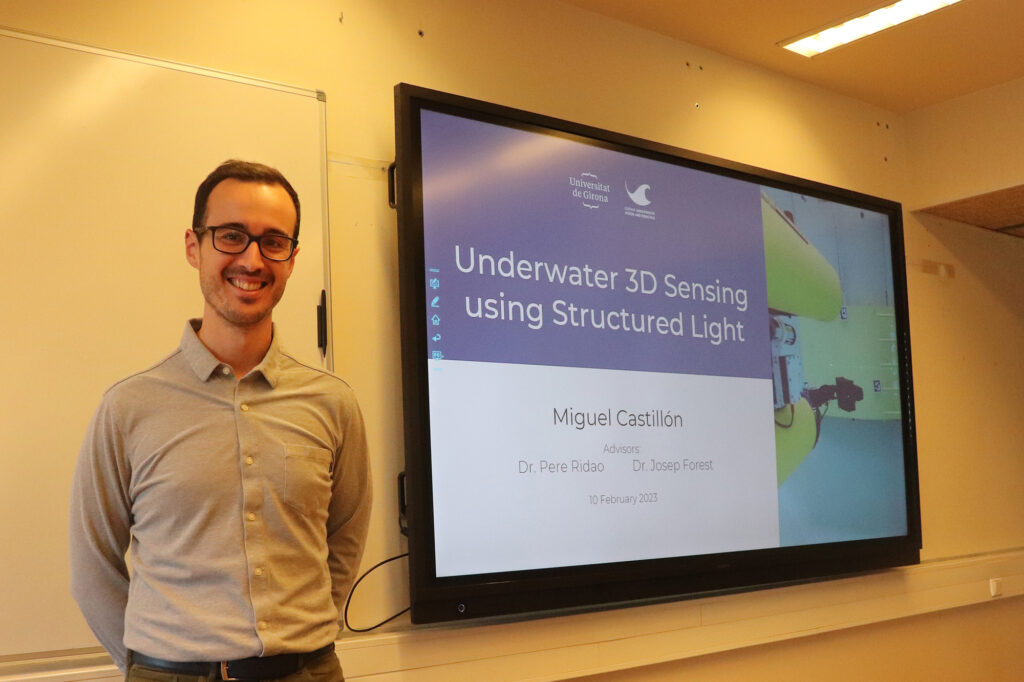
By Miguel Castillón Sánchez
Supervised by Dr.Pere Ridao Rodríguez / Dr. Josep Forest Collado
Abstract
Accurate underwater 3D perception is essential to advance towards the automation of expensive, dangerous and/or time-consuming tasks, such as the inspection, maintenance and repair of off-shore industrial sites. Accurate underwater 3D sensors can potentially have a large positive impact on the progress of tasks like object detection and semantic mapping, which are key to the development of robotic platforms capable of a higher level of abstraction. Moreover, these advances would decidedly contribute to the transition from remotely operated vehicles (ROVs) towards autonomous underwater vehicles (AUVs) in industrial operations. However, accurate underwater 3D perception is very hard to achieve because of the many physical particularities of light propagation in water, including refraction: the direction of light rays changes due to the different refraction indices of the media it travels through.
This thesis focuses on the development of a novel underwater 3D scanner and a non- rigid point cloud registration method aimed at enabling underwater 3D reconstructions with accuracies in the order of millimeters both in static and dynamic missions.
The thesis is structured according to these two main contributions, which resulted in five journal articles. The first main contribution of this thesis is designing and building an underwater 3D scanner using a 2-axis mirror. The second axis of the rotating mirror allows us to project optimally-curved scanning patterns designed to counteract refraction, so that they transform into straight lines when entering the water. This results in a decrease in computational complexity of the 3D reconstruction while maintaining millimeter accuracy. Minor contributions of this part of the thesis are the design of a ray-tracing model to study the effect of each optical component on the quality of the 3D reconstruction and the development of a simplified calibration algorithm based on numeric projection functions. The second main contribution of this thesis is the development of a non-rigid point cloud registration method that can successfully minimize the motion distortion that appears when the scanner is mounted on a moving robot.
Finally, this thesis also includes unpublished 3D reconstructions performed during missions both in the water tank at the Centre d’Investigació en Robòtica Submarina (CIRS) and at sea.
https://www.udg.edu/en/ed/tesis-doctorals/llista-de-tesis/codi/350130813