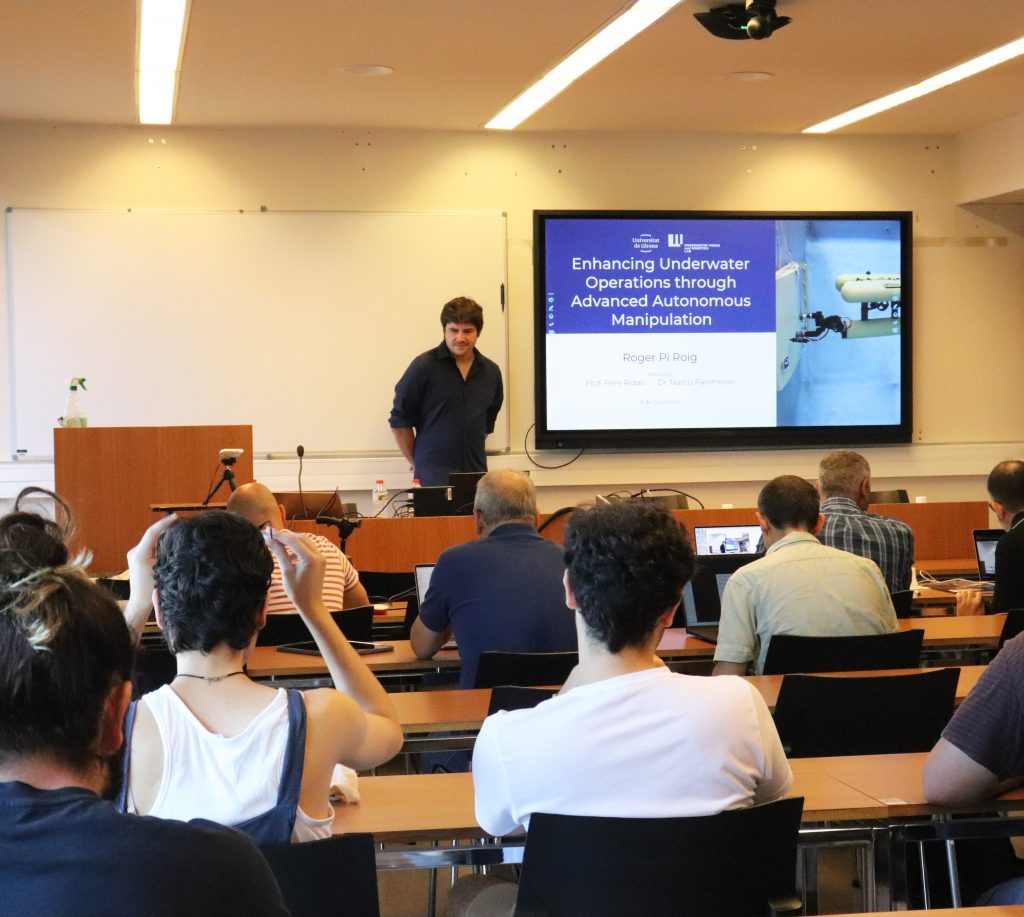
By: Roger Pi Roig
Supervised by: Dr. Pere Ridao Rodríguez / Dr. Narcís Palomeras Rovira
Abstract:
The interest in the use of autonomous underwater vehicles (AUVs) has increased in recent decades. While former research focused on underwater exploration for sea bottom map- ping (bathymetries, sonar, and photo mosaics), it evolved soon into 3D optical reconstruction and offshore infrastructure inspection. Progress in these areas has sparked the interest of the community in employing AUVs for intervention tasks, thereby replacing remotely operated vehicles (ROVs) and manned submersibles with intervention autonomous underwater vehicles (I-AUVs). This substitution offers the potential to automate tasks, improving efficiency and repeatability while reducing costs, time, and logistics. However, autonomous intervention underwater is challenging. It requires the joint control of a heterogeneous multibody sys- tem composed of the AUV and the manipulators, which have significant differences in terms of control and accuracy.
Most intervention tasks, such as object grasping or valve turning, require centimeter accuracy in the position of the end effector. This accuracy is severely affected by a chain of errors, beginning with the navigation error and continuing with the cal- ibration errors of the involved systems, including inaccuracies in the positions of the cameras, lasers, and manipulators, joint calibration errors, and other uncertainties within the system. Another challenge is the manipulation of bulky objects which are difficult, if not impossi- ble, to satisfy with a single vehicle. Most probably, future autonomous intervention systems will be multi-robot. This poses new problems to solve, like the joint control of a team of I-AUVs coordinated through low bandwidth communication channels. Finally, it is necessary to root the autonomous underwater intervention research to the actual needs of field appli- cations. This thesis is a contribution along these lines. It aims to advance the autonomous underwater intervention state of the art to increase the autonomy of I-AUVs for inspection, maintenance, and repair (IMR) tasks in offshore infrastructures. First, a new framework is proposed to calibrate the intrinsic/extrinsic parameters of the I-AUVs components, using ro- bust modeling of the minimization equations leveraging Lie theory. Then, the Task Priority redundancy control algorithm is enhanced to control two I-AUVs, communicating through a low-rate communications channel to transport a bulky object.
Finally, an effort is made to study the actual capabilities of I-AUVs to face field applications in the area of offshore re- newable energies. A Task Priority algorithm supporting admittance control is used to control an I-AUV performing non-destructive inspection for cathodic protection on a floating semi- submersible windmill structure. Throughout the thesis, all the works present both simulation and experimental results, validating the efficiency and potential of the proposed solutions.
https://www.udg.edu/en/ed/tesis-doctorals/llista-de-tesis/codi/350130813