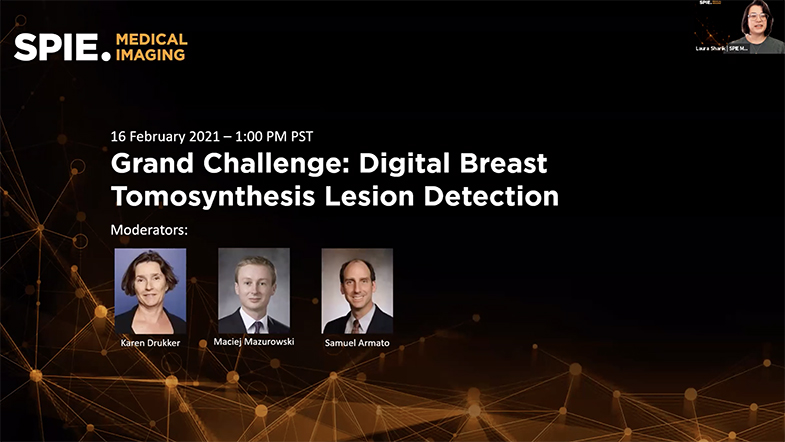
The Medical Image Analysis Lab participated this last January in the Digital Breast Tomosynthesis Lesion detection Challenged, jointly organized by the International Society for Optics and Photonics (SPIE), the American Association of Physicists in Medicine (AAPM), the National Cancer Institute (NCI) and the Duke Center for Artificial Intelligence in Radiology (DAIR).
The team achieved a well deserved third place in the challenge, after the teams from New York University (USA) and IBM Haifa Research Lab (Israel), and had the chance to present their lesion detection approach at the SPIE Medical Imaging Conference, usually celebrated in the USA but this time held online due to COVID-19 pandemic.
You can check the presentation at https://spie.org/conferences-and-exhibitions/medical-imaging/digital-detection-challenge and you can find the results of challenge at http://spie-aapm-nci-dair.westus2.cloudapp.azure.com/competitions/4#results
The research presented in the challenge is a result of the ongoing research in the ICEBERG research project on Image Computing for Enhancing Breast Cancer Radiomics, leaded by Robert Martí in VICOROB and with the collaboration of the Universidad Complutense de Madrid, Parc Taulí, Hospital Josep Trueta and Clínica Girona.