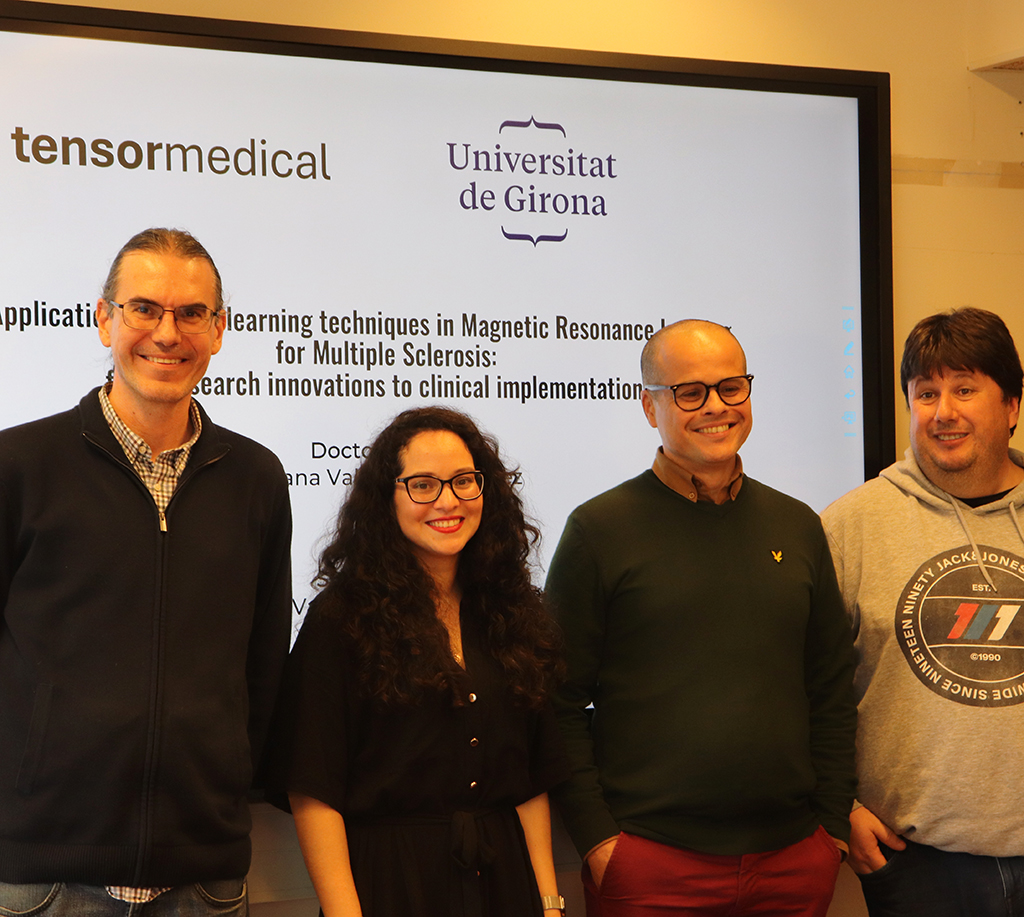
By: Liliana Valencia Rodríguez
Supervised by: Dr. Xavier Lladó, Universitat de Girona / Dr. Sergi Valverde, Tensormedical / Dr. Arnau Oliver, Universitat de Girona
Abstract:
This thesis explores how advanced artificial intelligence techniques, specifically deep learning, can improve the analysis of brain scans (MRI) for people with multiple sclerosis (MS) in the clinical practice.
The study focuses on three key areas. First, it introduces a new AI tool designed to accurately and consistently isolate the brain from the surrounding tissues in MRI scans. This is crucial for many analyses and can improve the accuracy of brain volume measurements, which are important for tracking disease progression. Secondly, the research develops a method to generate synthetic brain scans from existing ones. This can help improve the detection of MS lesions (areas of brain damage) while potentially reducing the need for expensive and time-consuming MRI scans.
Finally, the study investigates the practical challenges of bringing these AI tools into real-world clinical use. This includes navigating regulations and ensuring the safety and effectiveness of these technologies for patients.
In summary, this research aims to improve the diagnosis and management of MS by developing and implementing innovative AI solutions for analyzing brain MRI scans.