By: Sana Nazari
Supervised by: Dr. Rafael Garcia
Abstract:
Skin cancer remains one of the most prevalent and deadly forms of cancer worldwide, with melanoma alone accounting for over 330,000 new cases and nearly 60,000 deaths in 2022. Early detection is critical, as survival rates drop dramatically from 99% to just 30% once the cancer has metastasized.
This thesis was conducted within the Computer Vision and Robotics (VICOROB) group and the European Union iToBoS project. It advances AI-driven tools for skin cancer diagnosis with a focus on clinical and dermoscopic image analysis to support a two-tiered screening workflow.
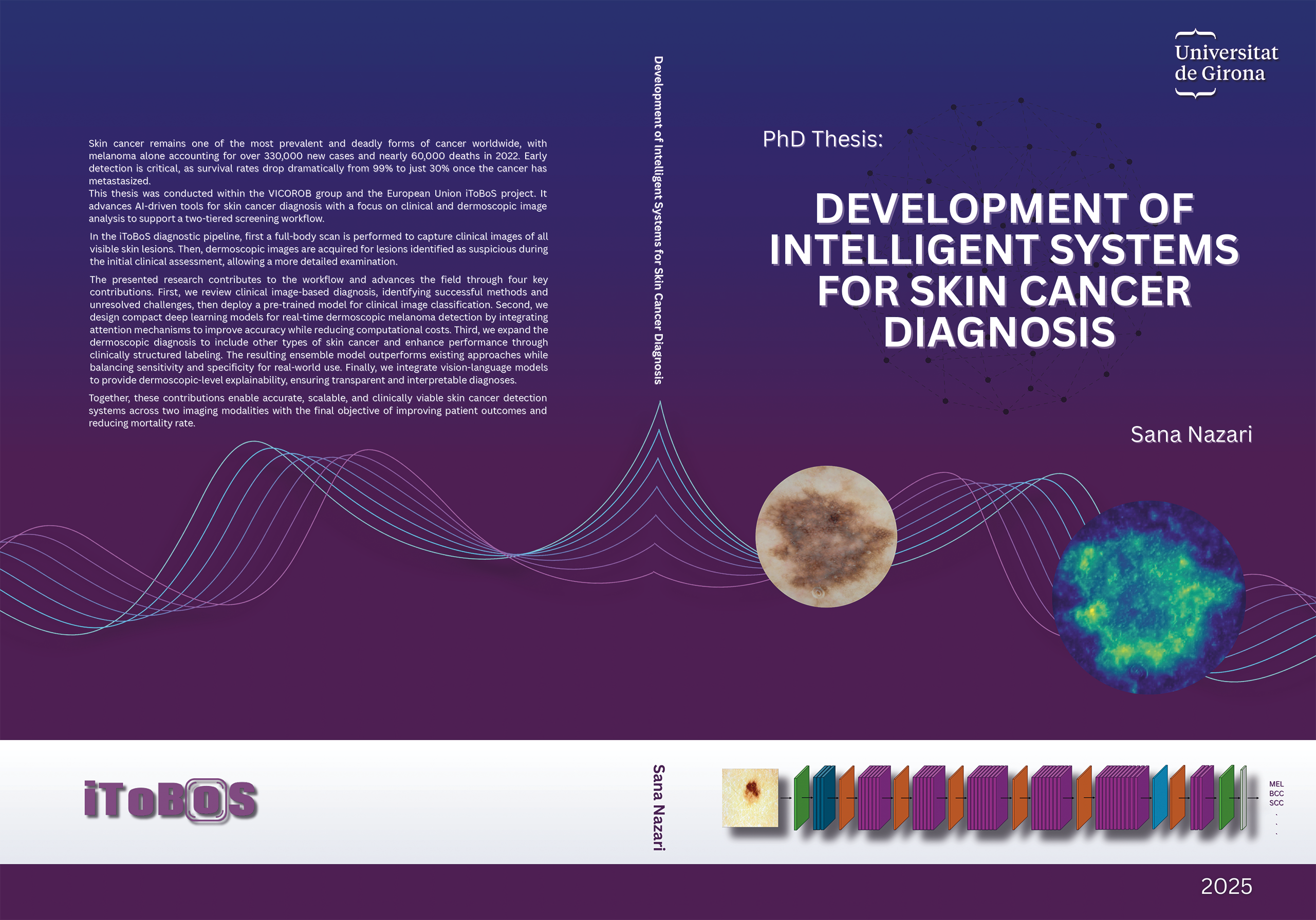
In the iToBoS diagnostic pipeline, first a full-body scan is performed to capture clinical images of all visible skin lesions. Then, dermoscopic images are acquired
for lesions identified as suspicious during the initial clinical assessment, allowing a more detailed examination.
The presented research contributes to the workflow and advances the field through four key contributions. First, we review clinical image-based diagnosis, identifying successful methods and unresolved challenges, then deploy a pre-trained model for clinical image classification. Second, we design compact deep learning models for real-time dermoscopic melanoma detection by integrating attention mechanisms to improve accuracy while reducing computational costs. Third, we expand the dermoscopic diagnosis to include other types of skin cancer and enhance performance through clinically structured labeling. The resulting ensemble model outperforms existing approaches while balancing sensitivity and specificity for realworld use. Finally, we integrate vision-language models to provide dermoscopiclevel explainability, ensuring transparent and interpretable diagnoses.
Together, these contributions enable accurate, scalable, and clinically viable skin cancer detection systems across two imaging modalities with the final objective of improving patient outcomes and reducing mortality rate.