By: Ricardo Montoya del Angel
Supervised by: Dr. Robert Martí Marly
Thesis Overview
Artificial intelligence (AI) holds high potential for automated medical diagnosis, but relies heavily on vast, well-annotated datasets. In specialized fields like Contrast-Enhanced Mammography (CEM) or point-of-care echocardiography, data scarcity remains a critical bottleneck for clinical deployment. This thesis investigates probabilistic generative modeling strategies to synthesize realistic, clinically valid medical data across three levels of complexity:
- Physically-Informed Uncertainty: Maps acquisition and annotation uncertainties into bounded generative variance, enhancing radiomic biomarker prediction in small CEM cohorts.
- Controllable Mammography Synthesis: Leverages latent diffusion models for full-field synthesis and localized lesion inpainting, transferring knowledge to data-scarce CEM.
- Efficient Video Synthesis: Combines 1D tokenization and masked transformers to reconstruct missing echocardiographic views (2-chamber from 4-chamber), enabling Ejection Fraction estimation on portable ultrasound devices.
The findings support the idea that synthetic data generated with physical and clinical rigor effectively overcomes clinical data constraints, enhancing diagnostic accuracy and decision support in clinical practice.
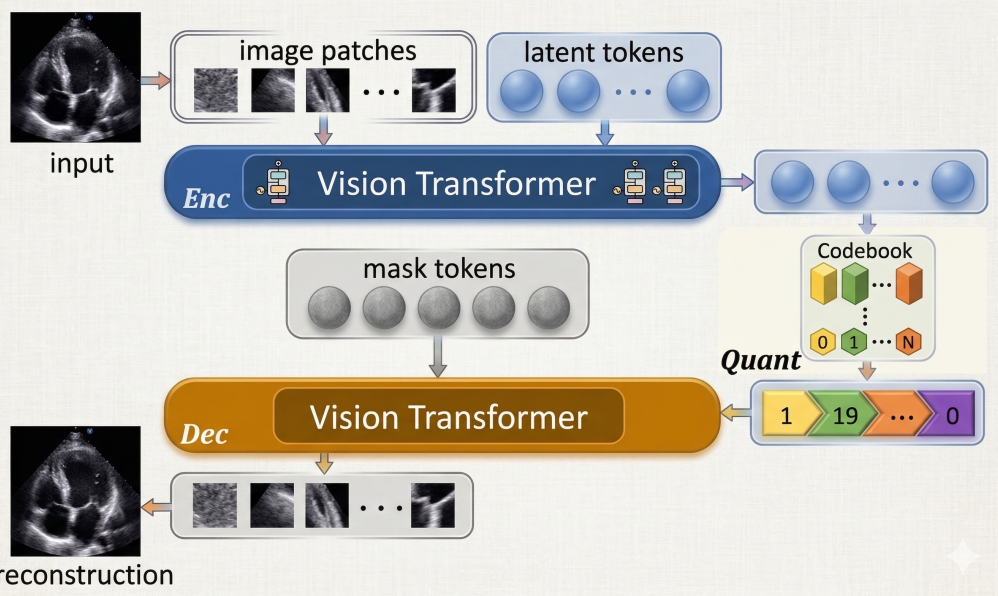
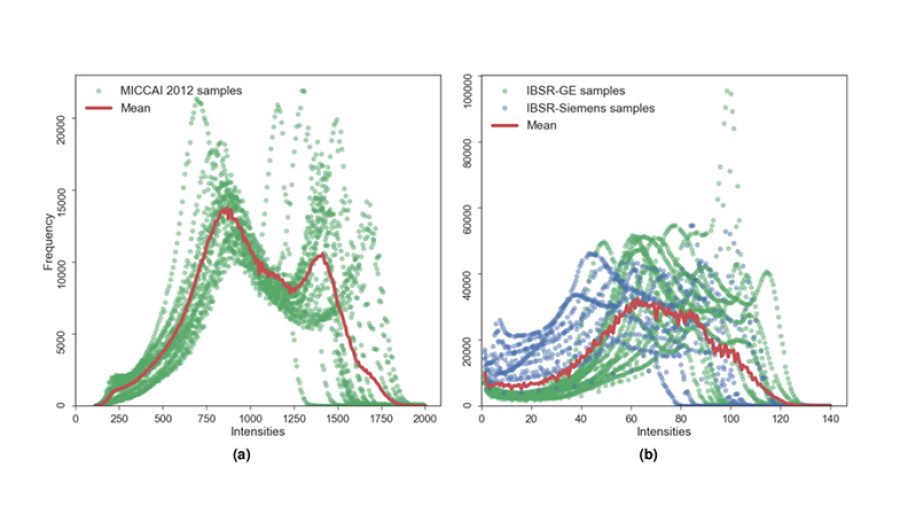
Photo: Illustration of the research developed in the doctoral thesis on generative modeling for medical data synthesis.