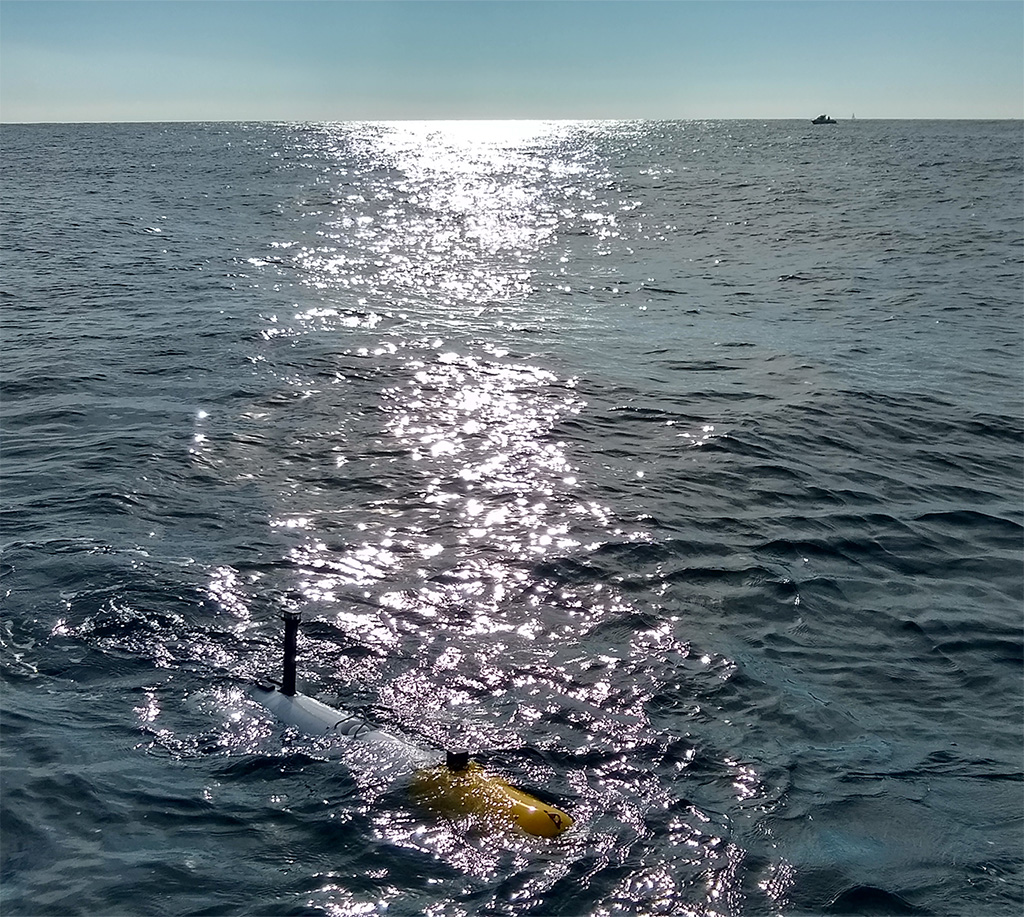
How can we continuously observe marine ecosystems when the ocean is vast and difficult to access? The PLOME project has developed and validated key technologies for a modular approach that combines fixed benthic stations, autonomous underwater vehicles and underwater communication systems for long-duration marine observation.
Observing the Ocean Over Time
Marine ecosystems change both over time and across space. Understanding these changes requires observations that go beyond one-off studies, particularly when examining seabed environments.
PLOME has explored how fixed and mobile autonomous systems can work together to support long-duration marine observation. The concept combines benthic stations, which remain on the seabed, with autonomous underwater vehicles (AUVs) capable of moving through the environment and collecting data.
The stations provide observations from fixed locations, while AUVs add mobility and allow the observation area to be expanded. The project has also developed and tested underwater communication and docking technologies to facilitate interaction between the different elements and support longer-duration autonomous missions.
Autonomous Observation Trials at Sea
Several of these technologies were tested under real marine conditions during PLOME’s experimental campaigns.
In 2024, the Girona 1000 AUV, developed at the University of Girona, demonstrated autonomous docking and undocking with an underwater docking station. The vehicle was able to start a mission from the station, carry it out and autonomously return to the station.
During the final sea trials in July 2025, the consortium tested different elements of the PLOME concept aboard the oceanographic research vessel Sarmiento de Gamboa, including AUVs, benthic landers and underwater communication systems.
During these trials, the Girona 1000 also carried out adaptive surveys: images were analyzed on board and, when potentially relevant features were detected, the vehicle was able to modify its trajectory. This approach allows an autonomous vehicle to adapt its mission based on information gathered during the survey.
Why Are These Advances Important?
Combining fixed and mobile autonomous systems makes it possible to collect observations at different spatial and temporal scales, which is relevant for the study of marine ecosystems.
PLOME has explored how these technologies can support long-duration and adaptive observation of marine environments, generating information that can contribute to research and ecosystem monitoring, as well as to the development of ecological indicators for the assessment of Marine Protected Areas.
PLOME on Video
Project Summary
Project: PLOME – Long-Term Platform for the Observation of Marine Ecosystems
Reference: PLEC2021-007525
Duration: December 2021 – September 2025
Coordinator: University of Girona
Partners: Universitat Politècnica de Catalunya, Universitat de les Illes Balears, Universidad Politécnica de Madrid, Institute of Marine Sciences (ICM-CSIC) and IQUA Robotics.