A VICOROB researcher is the first author in a ground-breaking study that is able to parcellate the brain in an unprecedented detail.
A new AI-assisted brain atlas that can help visualise the human brain in unprecedented detail in a major step forward for neuroscience and neuroimaging. The work is led by Dr. Juan Eugenio Iglesias (University College London and Harvard Medical School) and Adrià Casamitjana, a VICOROB (UdG) researcher, is the first-author
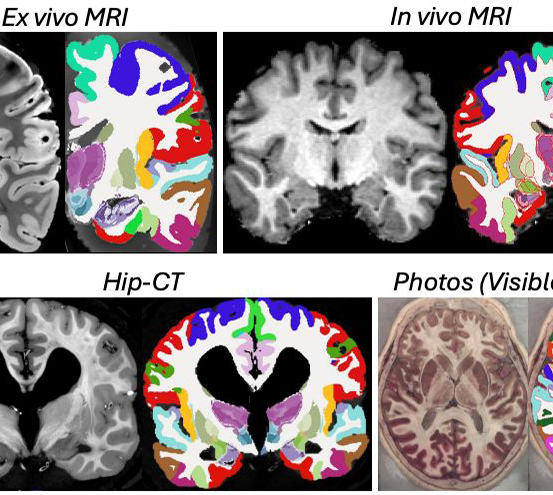
The human brain comprises hundreds of interconnected regions that drive our thoughts, emotions, and behaviours. Existing brain atlases can identify major structures in MRI scans – such as the hippocampus, which supports memory and learning – but their finer sub-regions remain hard to detect. These distinctions matter because sub-regions of the hippocampus, for example, are affected differently during Alzheimer’s disease progression.
Examining the brain at the cellular level is achievable using microscopy (histology), but cannot be done in living individuals, limiting its potential for understanding how the human brain changes during development, ageing and disease.
Published in Nature, the new study introduces NextBrain, an atlas of the entire adult human brain that can be used to analyse MRI scans of living patients in a matter of minutes and at a level of detail not possible until now.
The creators of the atlas, which is freely available, hope it will ultimately help to accelerate discovery in brain science and its translation into better diagnosis and treatment of conditions such as Alzheimer’s.