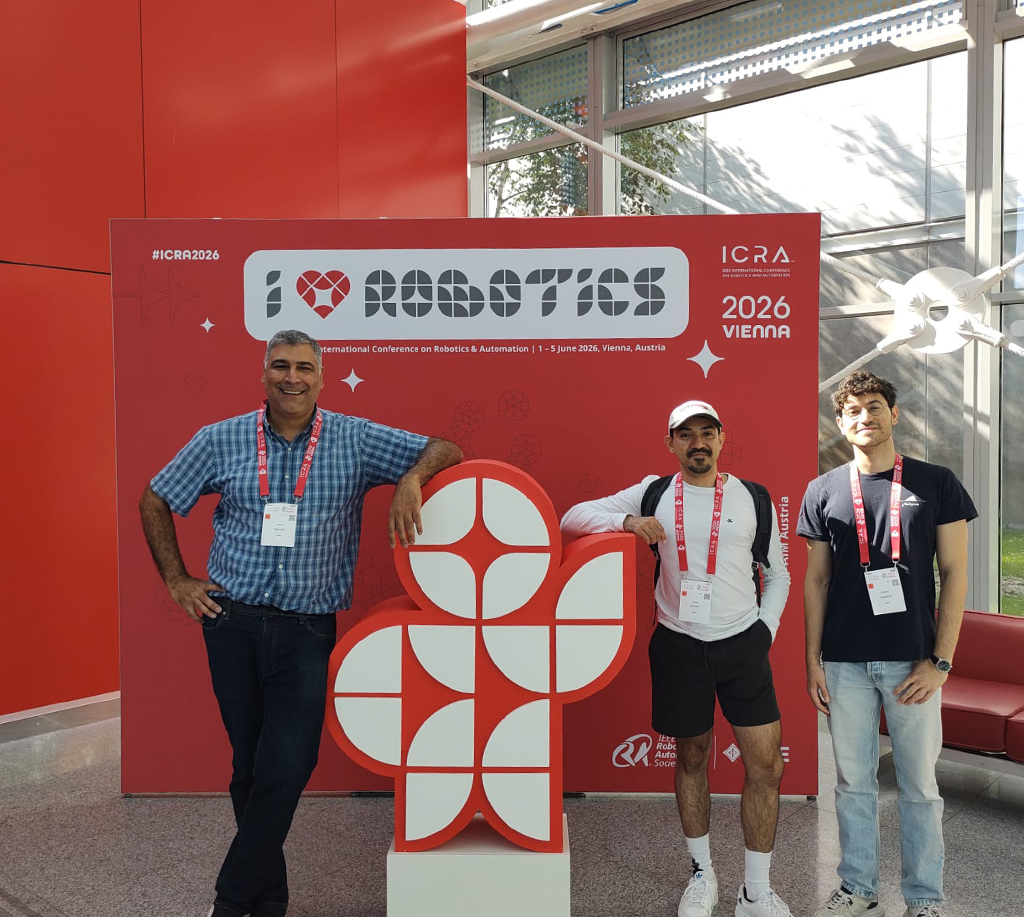
Researchers from ViCOROB presented the latest results of the IURBI project, together with several advances in medical and robotic vision research, at the IEEE International Conference on Robotics and Automation (ICRA 2026), the world’s leading conference on robotics and automation, held in Vienna.
The project aims to develop new machine learning approaches for the Girona1000 AUV, that integrates side-scan sonar with a dual-camera optical system, to enhance underwater mapping and blue carbon inventory, providing valuable information for environmental monitoring and conservation efforts. By generating and analysing side-scan sonar maps in real time, the robot can interpret the underwater environment as it explores the seafloor and autonomously adapt its mission based on the information it acquires, improving the efficiency and quality of underwater inspection and mapping operations.
The work was presented by Dr. Nuno Gracias, together with PhD candidates Hayat Rajani and Valerio Franchi from CIRS. The poster introduce the first underwater stereo event-camera setup developed within the project. The system uses an AMD Kria KV260 to preprocess the large volume of event data before feeding it to a SpiNNode neuromorphic board, built around the SpiNNaker2 chip, which runs spiking neural networks for classification. The high temporal resolution and high dynamic range of event cameras cope with the rapid motion and uneven illumination underwater, while their low power consumption supports the long survey missions that broad blue carbon inventory requires.
Valerio and Hayat also took the opportunity to present ongoing work from two other projects. One of the posters introduced a multi-robot system for total body photography at dermatoscopic image quality, a line of research begun under the iToBoS project and continued since its conclusion. The work-in-progress framework uses four UR10 manipulators with end-effector cameras, combining view planning and multi-robot scheduling with a real-time mole tracker in a visual servoing loop, allowing it to adapt to individual patient anatomies and capture consistent high-resolution images while reducing examination time and operator dependency. The other poster reported preliminary results from the ongoing tech transfer project OculaRobot an autonomous framework for precision intravitreal injection, one of the highest-volume medical procedures worldwide. The system pairs a 6-DOF collaborative manipulator with a trifocal stereoscopic vision rig for real-time 3D tracking of the eye and needle, using visual servoing and force feedback to target sub-millimetre positioning accuracy. Both posters were presented at the well-regarded workshop on robot-assisted medical imaging, RAMI .
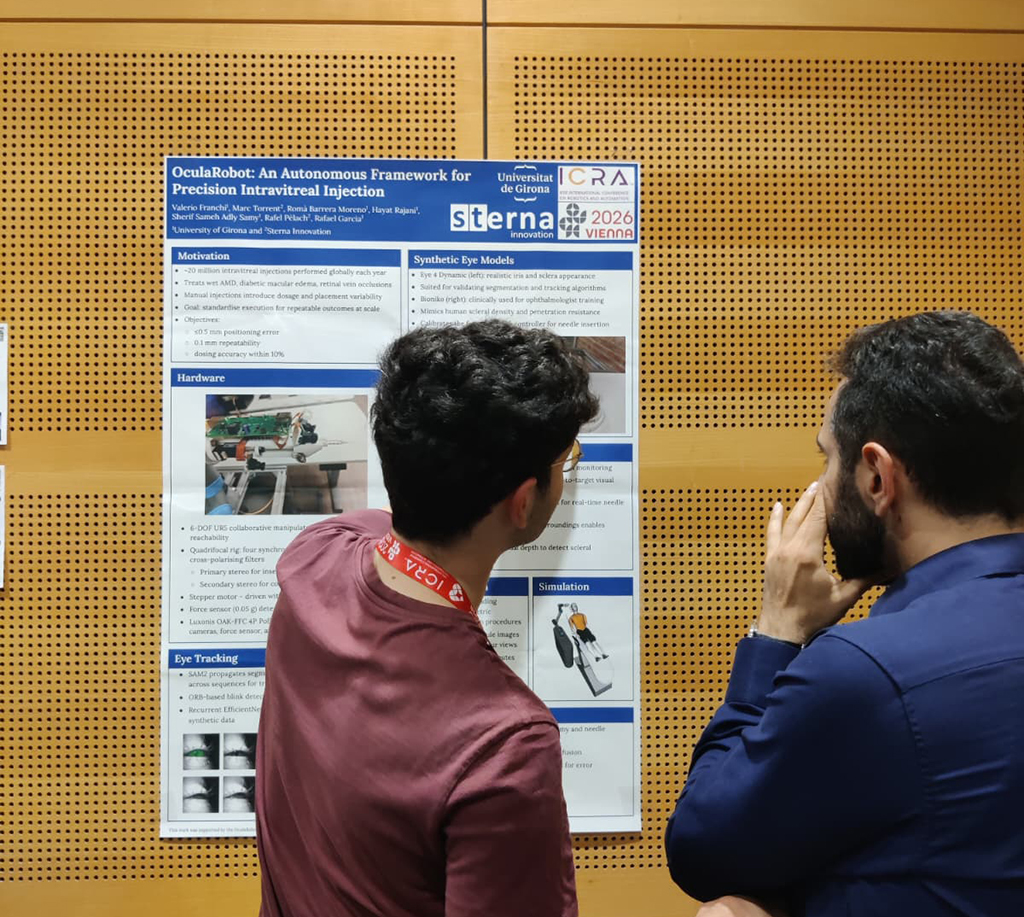
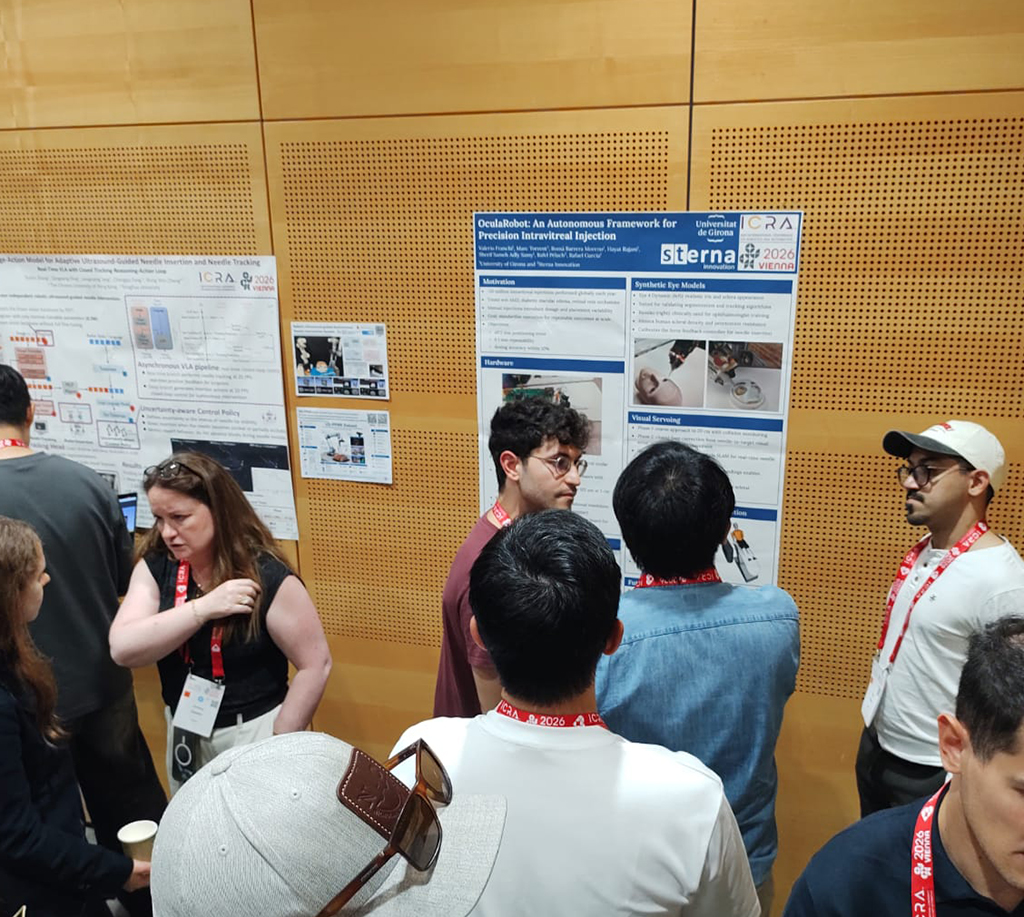
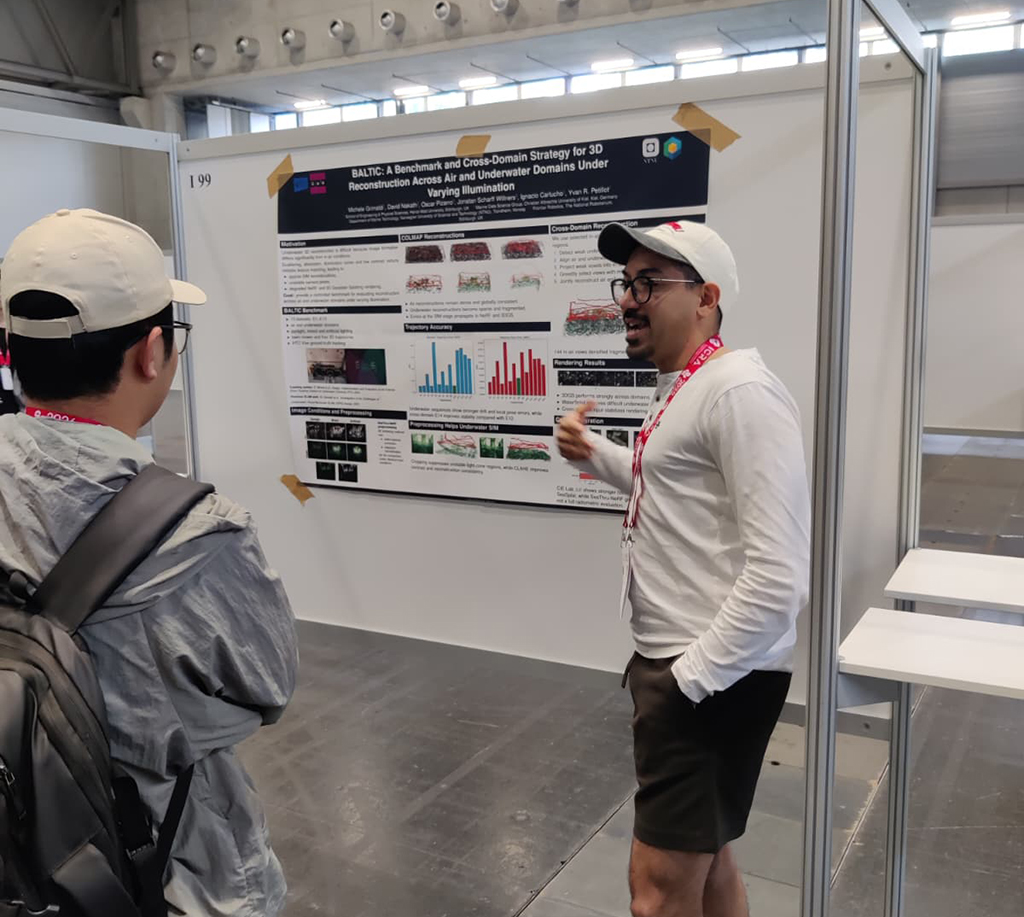
Additionally, Hayat presented a poster from the work carried out at Heriot-Watt University, introducing a controlled benchmark designed to systematically evaluate modern 3D reconstruction methods under variations in medium and lighting. The benchmark comprises 13 datasets spanning two media (air and water) and three lighting conditions (ambient, artificial, and mixed), with additional variations in motion type, scanning pattern, and initialization trajectory, resulting in a diverse set of sequences.
Funded by the Agencia Estatal de Investigación (AEI) and the NextGenerationEU programme, the IURBI project is now entering its final stage. The technologies developed within the project contribute to the advancement of more intelligent and autonomous underwater robotic systems, with potential applications in marine exploration, environmental monitoring and the conservation of marine ecosystems, reinforcing the role of technological innovation in addressing scientific and societal challenges.