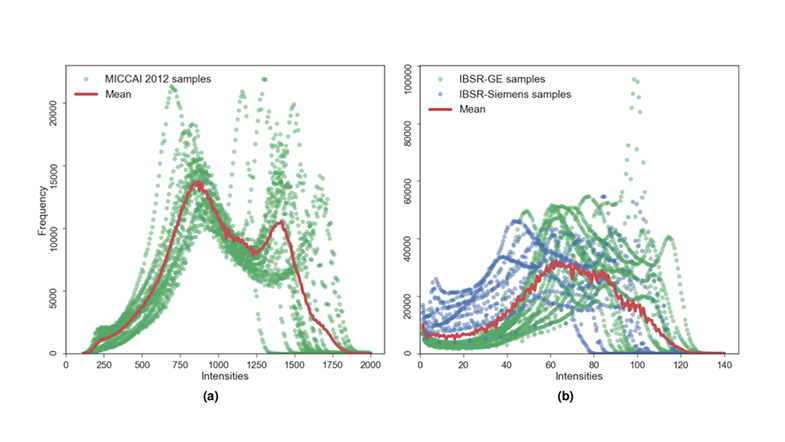
In recent years, the deep learning based methods achieved the state of the art for medical image segmentation. However, these methods are sensitive to image intensity distribution changes such as different MRI scanner or protocol. Therefore, a neural network has to be retrained to perform similarly in other datasets. In this paper, we investigated the use of transfer learning strategy to overcome the changes in the data distribution. We reduced the number of training images by leveraging the knowledge obtained by a pre-trained network and improved the training speed by reducing the number of trainable parameters of the CNN. We tested our method on two publicly available datasets – MICCAI 2012 and IBSR – and compared them with a commonly used approach: FIRST. Our method showed similar results to those obtained by a fully trained CNN, and our method used a remarkably smaller number of images from the target domain.
Article from Kaisar Kushibar “Supervised Domain Adaptation for Automatic Sub-cortical Brain Structure Segmentation with Minimal User Interaction” in Scientific Report journal.
https://www.nature.com/articles/s41598-019-43299-z